“Chatbot” and “conversational AI” overlap more than the terms suggest. A chatbot is an interface: software people interact with in a chat window or message thread. Conversational AI is a set of technologies for understanding language and producing replies. Traditional chatbots used scripted flows and a fixed set of recognized intents. Many chatbots today use generative AI, which can handle open-ended requests but can also produce answers that are wrong, inconsistent or outside the product’s scope. For UX, the important difference is not the label but how the system behaves, what people expect from it and how it fails.
This comparison explains the overlapping terms, compares typical capabilities, and shows how user expectations, conversation design and recovery change between scripted and generative systems. It uses agency-published product examples with clear attribution. For implementation patterns, see our chatbot UX design guide and AI interface design guide.
Explain the overlapping terms
Vendors and teams use these words loosely, so it helps to separate three ideas.
The interface. A chatbot is a conversational interface. It can appear on a website, in an app, in messaging or by voice. The interface alone says nothing about the technology behind it.
Scripted or intent-based conversation. The system recognizes a set of intents, such as “track my order” or “change my address”, and follows designed flows for each. Responses are written in advance. When a request falls outside the known intents, the system cannot handle it well.
Generative conversation. The system uses a language model to interpret requests and generate replies. It can respond to a far wider range of input and phrase answers naturally, but its responses are not written in advance and can be wrong.
“Conversational AI” is often used for the second and third together, and increasingly for the third alone. In practice, many products combine all three: a chat interface, scripted flows for sensitive tasks and generative replies for open questions. Treat the marketing category as a starting point and ask what the system actually does.
Compare observed capabilities
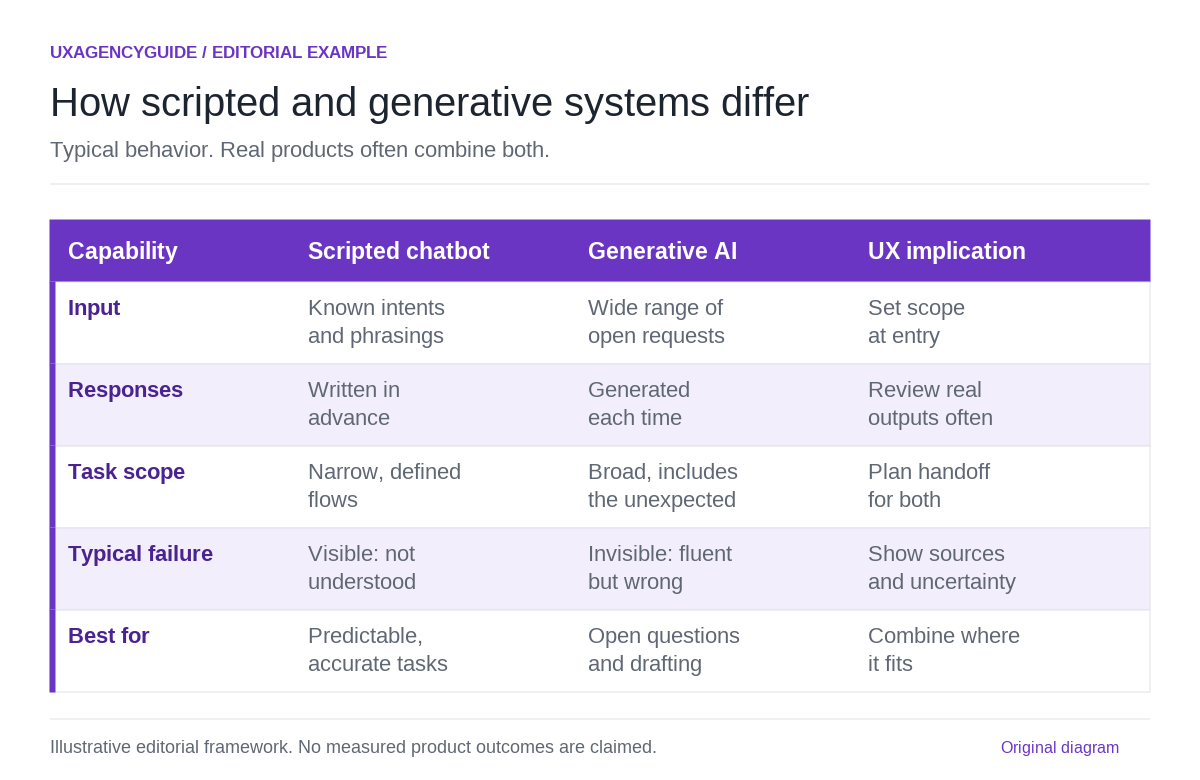
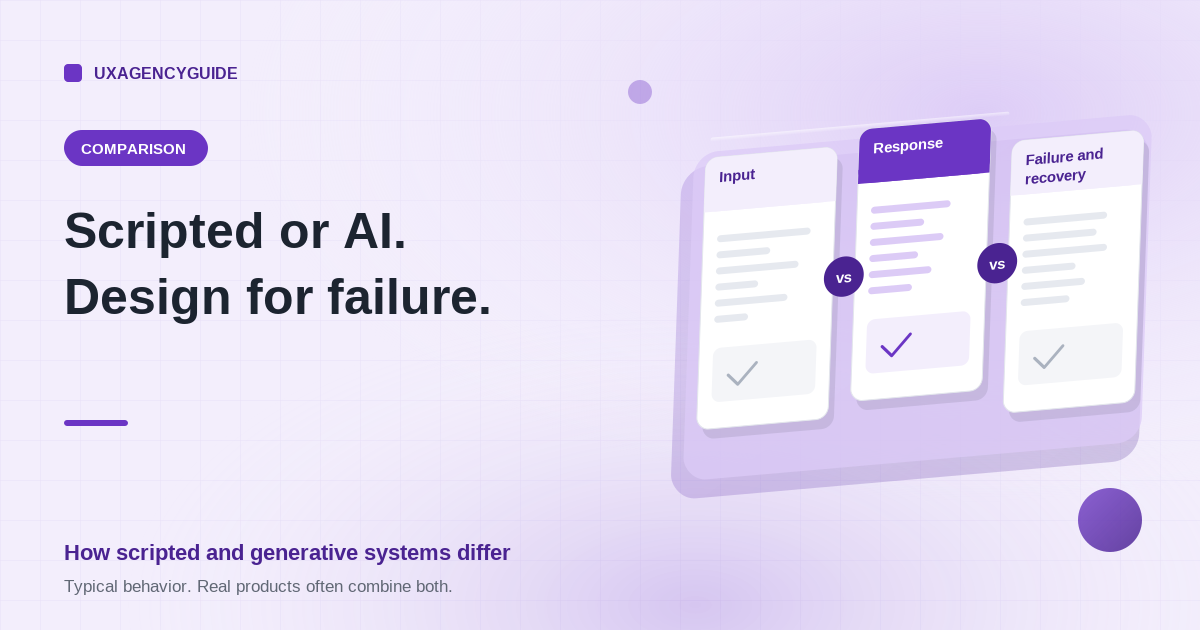
| Capability | Scripted chatbot | Generative conversational AI |
|---|---|---|
| Understanding input | Recognizes known intents and phrasings | Interprets a wide range of phrasing and open questions |
| Responses | Written in advance, consistent | Generated each time, variable |
| Task scope | Narrow, defined flows | Broad, including unanticipated requests |
| Typical failure | “I didn’t understand that”, or a loop | A fluent but wrong or out-of-scope answer |
| What the failure looks like to users | Obvious | Often invisible |
| Testing | Test every flow and intent | Test with many realistic inputs and review outputs |
| Best suited to | Predictable, high-accuracy tasks | Open questions, exploration, drafting |
The most important row for UX is the typical failure. A scripted bot fails visibly: it says it does not understand, or it sends people round in circles. Frustrating, but obvious. A generative system can fail invisibly: it answers confidently and fluently, and the answer is wrong. That changes what the interface has to do.
User expectations and limitations
People calibrate their expectations from how a system talks.
Scripted bots set low expectations
Nielsen Norman Group’s research on the user experience of chatbots, published in 2018 before generative chat became common, found that chatbots worked for simple, linear tasks and that people had trouble when they strayed from the expected flow. Its recommendations included being upfront that users are talking to a bot rather than a human and providing an escape hatch when the bot fails. Those findings still describe scripted bots well, though the research predates current generative systems and should be read in that context.
Generative systems set high expectations
A system that writes fluent, natural replies suggests that it understands the request and knows the answer. That impression is often stronger than the system’s real reliability. The risk is over-trust: people accept answers they should check.
Microsoft’s Guidelines for Human-AI Interaction address this directly. They begin with making clear what the system can do and how well it can do it, and include scoping services when in doubt and making clear why the system did what it did. For a generative chatbot, that means stating its scope at the start, signaling uncertainty, showing sources where possible and narrowing its answer when it is unsure rather than guessing.
Both need honest disclosure
Whether scripted or generative, people should know they are talking to software, what it can help with and how to reach a person. Disclosure is a basic expectation, and in some contexts a requirement.
Conversation and recovery differences
The design work differs most around failure and recovery.
Designing scripted conversations
For scripted systems, design concentrates on the flows. Each intent needs a clear path, prompts that guide people toward answers the system can handle, and a response when input is not recognized. Good recovery offers choices (“I can help with orders, returns or account details”) rather than repeating “I didn’t understand.” Think Company’s global media and technology case describes redesigning voice menu and chatbot intent handling so that requests are routed to an answer immediately; for scripted systems, good intent design is the main lever for a better experience. The agency lists conversational AI and intent design among its services.
Designing generative conversations
For generative systems, design has to account for answers that cannot be fully predicted. Useful patterns include:
- Scope at entry. Say what the assistant can help with and what it cannot.
- Evidence beside answers. Show sources or the data an answer is based on, so people can check it.
- Clarifying questions. When a request is ambiguous, ask rather than guess.
- Structure for results. Use tables, plans or panels when people need to review or act on an answer, rather than leaving everything in prose.
- Easy correction. Let people edit or redirect an answer without starting again.
Combining both
Many products use rules where accuracy and compliance matter and generative replies elsewhere. ustwo’s RVO Health case describes an SMS coaching product for people trying to stop smoking that combines deterministic rules for compliance with generative conversation, while human coaches remain involved. The agency reports engagement of 57% against 22% for the earlier scripted-only program. Those are the agency’s figures, but the design pattern is useful: decide which messages must be fixed, let the rest be generated, and keep people in the loop where judgment is needed.
Handoff for both
Both kinds of system need a clear route to a person. For scripted bots, handoff is triggered when the request falls outside known flows. For generative systems, it is also needed when the system is uncertain, when the stakes are high or when the user asks. In both cases, pass the conversation’s context so the person does not have to explain again.
Attributed product examples
The following examples come from agencies’ own case studies. They show approaches teams have published, not independent measurements.
Fuselab Creative, Stardog Voicebox. Fuselab Creative’s case describes a conversational AI workspace where financial analysts query datasets in natural language. Its design places the fund data table beside the chat, adds verification markers to each AI response and keeps a conversation library linked to source documents. This is a generative system designed so people can check answers against data, which directly addresses the invisible-failure problem.
Lazarev.agency, Accern Rhea. Lazarev.agency’s case describes an AI research tool where the agency concluded that a purely chat-based interface was not enough. It describes a widget-based interface that adapts to the conversation, a prompt field that works like a command line for actions and a system of clarifying questions and hints when a query is unclear. The example shows conversational AI moving beyond the chat window into structured interface elements.
ustwo, RVO Health. As described above, a hybrid of rules and generative conversation with human coaches involved.
Think Company, intent handling. As described above, improving a scripted system by routing requests to answers directly.
Together they show the range: scripted systems improved by better intents, generative systems made checkable, and hybrids that use each approach where it fits. For agencies with this experience, see our AI interface design agencies guide.
Measuring a conversational system
The two kinds of system need different measures, because they fail differently.
For scripted systems, track how often input is not recognized, where people abandon a flow, how often they ask for a person and whether they complete the task they came for. Those measures point directly at missing intents and confusing prompts.
For generative systems, add measures of answer quality. Review a sample of real conversations regularly and judge whether answers were correct, grounded in the right sources and within scope. Track how often people correct the assistant, rephrase the same question or abandon after an answer, which can signal a confident but unhelpful reply. Completion rates alone can hide over-trust, where people complete a task by accepting a wrong answer.
For both, record the reasons for handoffs to people. Those reasons are the most direct list of what the system should learn to do, or should stop trying to do.
Choose the required behavior
Start from the behavior your product needs, not from the label.
| If your users need to | Choose | Design priority |
|---|---|---|
| Complete a few predictable tasks accurately | Scripted flows | Clear options and recovery when input is not recognized |
| Ask open questions about a large body of information | Generative, with sources | Evidence beside answers and uncertainty signals |
| Get help on sensitive or regulated topics | Hybrid, with fixed rules for sensitive steps | Which responses must be fixed, and human review |
| Draft or explore ideas | Generative | Easy editing and clear ownership of the result |
| Take actions with consequences | Either, with confirmation | Review and confirm before anything happens |
Questions to decide
- What happens if an answer is wrong? If the consequence is serious, use fixed responses or require confirmation and sources.
- How predictable are the requests? A small set of predictable requests suits scripted flows.
- Can you test the system’s outputs adequately? Generative systems need ongoing review of real conversations.
- Who handles what the system cannot? Plan the human handoff before launch.
- How will you tell users what the system is? Disclosure and scope statements should be designed, not added later.
The label on the product matters less than these answers. A well-designed scripted bot that does three things reliably can serve people better than a fluent assistant that does many things unpredictably. A well-designed generative assistant, with clear scope, visible evidence and easy recovery, can help people with questions no script could anticipate.
Frequently asked questions
What is the difference between a chatbot and conversational AI?
Chatbot describes the interface: software you talk to in a chat. Conversational AI describes the technology that interprets language and generates replies, often using large language models. A traditional chatbot follows scripted flows and recognized intents; a chatbot built on generative AI can handle open requests but can also produce wrong or unexpected answers.
Is a rule-based chatbot ever better than generative AI?
Yes, for narrow, predictable tasks where accuracy and consistency matter more than flexibility, such as checking an order status or booking a slot. Scripted flows are easier to test and do not invent answers. Many products combine both, using rules for sensitive steps and generative replies elsewhere.
How do users’ expectations differ?
People expect less from an obviously scripted bot and often more from one that writes fluent sentences. Fluency suggests understanding and accuracy that the system may not have. Interfaces built on generative AI therefore need clearer signals about what the system can do, what it is unsure of and where its answers come from.
Do both need a human handoff?
Usually, yes. Scripted bots fail when a request falls outside their flows; generative systems fail when they misunderstand or produce a wrong answer. In both cases people need a clear route to a person or another channel, with the conversation’s context preserved.
Sources & evidence
- The user experience of chatbotsChecked 2026-11-20
- Microsoft HAX Toolkit guidelines for human-AI interactionChecked 2026-11-20
- Stardog Voicebox conversational AI interface designChecked 2026-11-20
- Accern Rhea design case studyChecked 2026-11-20
- RVO Health x ustwoChecked 2026-11-20
- Global media and tech companyChecked 2026-11-20
Specific sources, useful examples and clear limitations make advice easier to assess.
Read the editorial policy