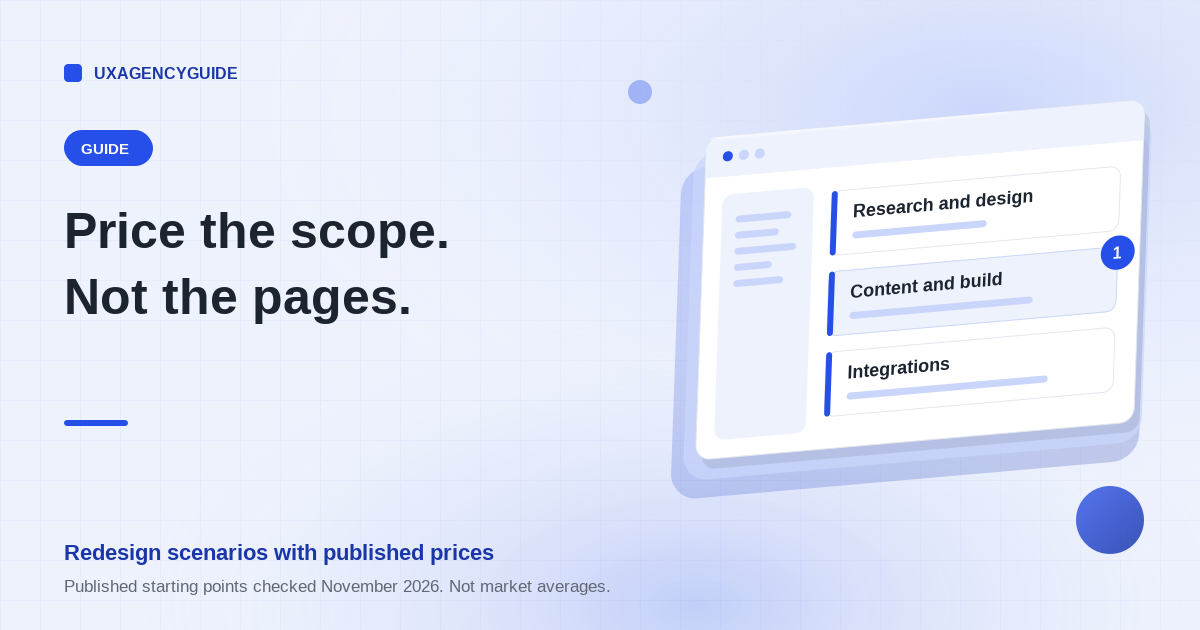
A website redesign costs whatever its scope requires, and scope is made of separate pieces of work: research, structure, visual design, content, build, integrations and launch. Quotes that look very different usually include different pieces, not different prices for the same work. To budget well, list the pieces your redesign needs, find out which ones each supplier includes and compare like with like.
This guide explains what a redesign quote should cover, how each part of the work affects cost and how to compare proposals. It uses prices that agencies and platforms publish on their own websites, checked in November 2026, and builds illustrative scenarios from them. Those figures are published starting points from named sources, not market averages or quotes for your project. Our UX agency hiring benchmark analyzes what 21 agencies publish about price and engagement terms.
What a redesign quote covers
A complete redesign has several stages. Some suppliers cover all of them; many cover only some.
- Discovery and audit: reviewing the current site, analytics, search terms, support questions and competitors.
- Structure and UX design: sitemap, navigation, page types, user journeys, wireframes and prototypes.
- Visual design: layouts, design system or style guide, responsive designs for each page type.
- Content: writing, editing, migration of existing pages, images and video.
- Build: developing the site on a chosen platform or custom code, including accessibility and performance.
- Integrations: forms, CRM, analytics, ecommerce, search, booking or other connected systems.
- Launch and support: testing, redirects for changed URLs, analytics setup, training and ongoing maintenance.
A quote that covers stages two and three only is a design quote. It may look inexpensive next to a full-service quote, but the content, build and launch work still have to be paid for by someone.
A published example of stage coverage
Arounda’s website redesign page describes three stages: a UX audit with product testing, competitor analysis and an audit report; UX and UI redesign including wireframes, concept design, prototyping, responsive layouts, user testing and a style guide; and design support that prepares final assets for development. That is a design-led scope, ending with handoff to whoever builds the site. The page publishes price ranges, covered in the scenarios below.
Research and design scope
Research and design are where redesigns succeed or fail, and they are also the parts most often cut to reduce a quote.
Start with an audit
An audit of the current site shows what to keep, what to change and what is causing problems. It can be short. Cieden’s UX audit service, for example, publishes tiers starting at $2,000 with delivery in five days for simple consumer websites or apps, rising for complex products and accessibility review. Our UX audit guide explains what a useful audit contains.
Decide whether the structure changes
The biggest scope decision is whether you are changing the site’s structure. A refresh keeps the existing navigation and page types and updates visual design and content. A redesign revisits who the site is for, what they need to do and how the site is organized. Redesigns cost more because they need research, new information architecture and testing.
Agente’s Just Reach Out case is an instructive example of restraint. The agency describes evaluating a SaaS company’s website through heuristic review and user-flow and mouse-tracking analysis, then choosing not to change the layout dramatically. Instead it added usage guidance, calls to action and visual emphasis on critical elements. The agency reports that conversion tripled two months after launch; that is its own and its client’s account. The lesson for budgeting is that evidence may show a smaller change will do, which a fixed plan to rebuild everything would miss.
Count page types, not pages
Design cost is driven by the number of distinct page types (homepage, product page, article, pricing, contact) more than by the total number of pages. A site with 200 articles built from one template may need less design work than a site with 15 unique pages. Content migration, on the other hand, scales with the number of pages.
Include prototyping and testing for key journeys
For journeys that matter commercially, such as signing up, requesting a demo or buying, a prototype tested with a few real users is cheap insurance. Our comparison of wireframes, mockups and prototypes explains which artifact suits which question.
Content, build and integrations
These stages are frequently underestimated or left out of design quotes entirely.
Content is often the longest task
Writing, editing and migrating content takes longer than most teams expect, and redesigns stall when designed pages wait for words. Decide early who writes new content, who approves it and how existing pages will be migrated, redirected or retired. If an agency provides content, confirm whether that means writing, editing, loading or all three.
Build depends on the platform
The build can be done on a website platform or in custom code. Platforms reduce build time and let non-developers edit content, at the cost of subscriptions and some limits. Framer’s pricing page lists site plans from free to $10 and $30 per month, with additional editors at $20 per month and custom enterprise pricing. Other platforms publish their own plans; check current prices on the vendor’s site and include subscription costs in the multi-year budget. Our Framer vs. Webflow comparison covers platform choice in more detail.
Custom builds suit sites with unusual requirements, heavy integrations or strict performance needs, but they cost more to build and to maintain.
Integrations multiply effort
Each connected system, such as a CRM, booking tool, ecommerce platform, search service or single sign-on, adds design, build and testing work. List every integration in the brief. A redesign that looks simple can become complex when it has to keep six existing systems working.
Design and build together or apart
Some agencies design and build; others design and hand off. Work & Co’s process page describes development starting at project kickoff, alongside design, and a full design cycle and prototype in about 20 days to get market feedback, with dedicated staffing. Its Canada Goose announcement describes leading strategy, concepting and detailed design for an ecommerce flagship built on a custom Shopify implementation, without stating who built it. Integrated models reduce handoff risk; separate design and build partners can reduce cost or let you use an existing development team. Either way, decide who resolves conflicts between design and build.
Scoped project scenarios
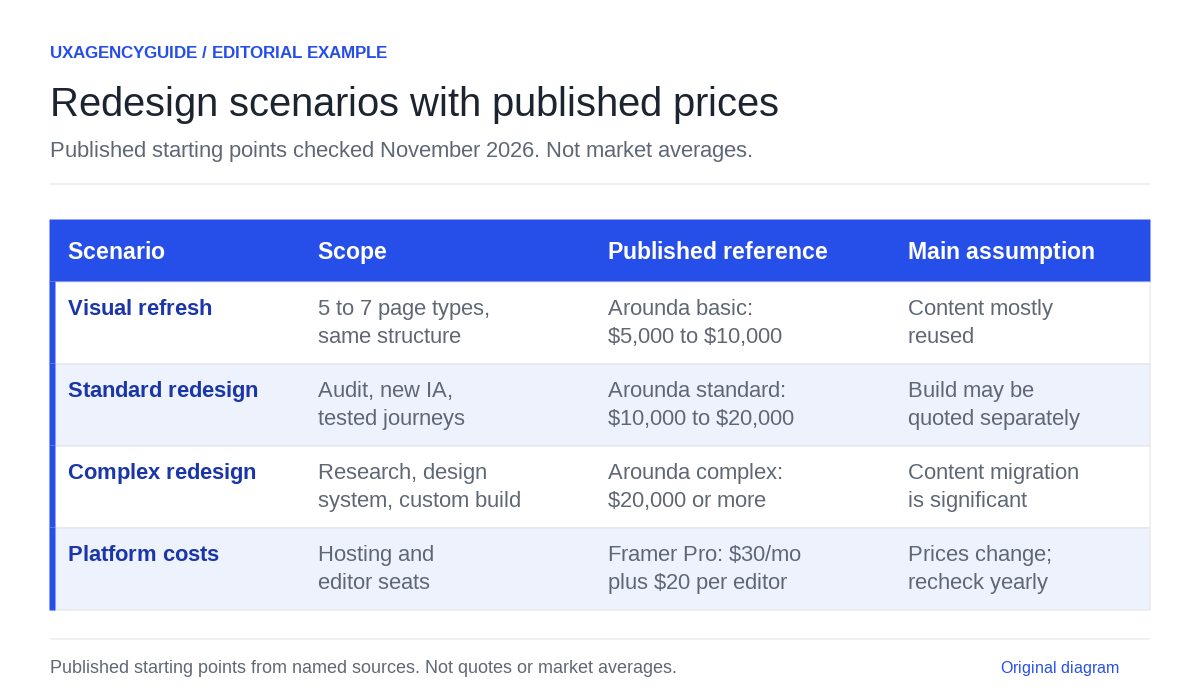
The scenarios below are illustrative. Each pairs a scope with a published price reference so you can see how the pieces add up. Your own costs will differ.
Scenario 1: a visual refresh of a small site
Scope: keep the structure, update visual design for five to seven page types, light content edits, rebuild on an existing platform.
Published reference: Arounda’s redesign page lists a basic redesign at $5,000 to $10,000 for up to five to seven pages, and estimates simpler redesigns at three or more weeks. Arounda’s pricing page says its typical projects start from $6,000.
Assumptions: content is mostly reused; the build is on an existing platform; no new integrations. Add platform subscription and any build work if the design agency does not build.
Scenario 2: a standard redesign with UX work
Scope: short audit, revised navigation and page types, prototypes of two key journeys, user testing, full visual design and style guide, content updates.
Published reference: Arounda lists a standard redesign at $10,000 to $20,000. A separate audit could be priced from published tiers such as Cieden’s from $2,000.
Assumptions: new content is written by your team or quoted separately; build may be a separate cost; one or two integrations.
Scenario 3: a complex or custom redesign
Scope: research with several audiences, new information architecture, many page types, design system, custom build, several integrations, accessibility testing.
Published reference: Arounda lists complex or custom redesigns at $20,000 or more and estimates seven or more weeks. Fuselab Creative’s published rates of $100 to $150 per hour, with engagements from $25,000, show how a specialist product agency prices larger work.
Assumptions: design and build are both included or separately quoted; content migration is significant; the timeline runs to months rather than weeks.
Platform running costs
Whichever scenario applies, add the platform. A small marketing site on a plan such as Framer’s $30 per month Pro tier, with one additional editor at $20 per month, costs $600 a year at those rates before domains, add-ons or price changes. Larger sites and enterprise plans cost more.
What changes the budget
These factors move a redesign budget more than the supplier’s day rate.
- Structural change: changing navigation and journeys requires research and testing.
- Number of page types: each distinct template needs design, build and testing.
- Content responsibility: writing and migration can equal or exceed design cost.
- Integrations: every connected system adds work and risk.
- Platform choice: platform builds are faster to deliver; custom builds are more flexible and cost more to maintain.
- Accessibility and performance targets: meeting a defined standard requires design, build and testing time.
- Stakeholders and approvals: more decision-makers mean more review rounds and longer timelines.
- Timeline pressure: compressed schedules need larger teams working in parallel.
When a quote seems high or low, check these first. A low quote often excludes content and integrations; a high one may include research, testing and support that a lower quote leaves to you.
Timeline and payment structure
Cost and timeline are linked. Published estimates give a sense of scale: Arounda estimates simpler redesigns at three or more weeks and complex ones at seven or more, while Work & Co describes reaching market feedback on a first design cycle and prototype in about 20 days. Real timelines depend as much on your side as on the supplier’s: how quickly content is supplied, how many people approve designs and how available your developers are.
Common payment models
Agencies usually price redesigns in one of three ways.
- Fixed price: a set fee for a defined scope. Predictable, but changes need formal change requests, so the brief must be precise.
- Time and materials: you pay for the time spent, often against an estimate. Flexible when scope is uncertain, but requires closer budget tracking.
- Phased: a fixed or capped price for discovery and design, then a separate estimate for build once scope is clear. Often the best fit for redesigns that may change structure.
Ask how changes are handled under each model, what happens if content arrives late and when payments are due. A phased approach lets you check the agency’s understanding of your site before committing the larger build budget.
Questions to ask before signing
- Which stages are included, and which are excluded or optional?
- Who writes, loads and approves content?
- How many design review rounds are included, and what happens after that?
- Which platform will the site use, and who owns the accounts?
- Are redirects, analytics and accessibility testing included?
- What support is included after launch, and for how long?
- Who owns the design files, code and content at the end?
Written answers to these questions turn a headline price into a scope you can hold the supplier to, and they make it far easier to compare proposals fairly.
Compare proposals and exclusions
Ask every supplier to respond to the same brief, such as our UX design brief template, and to itemize their proposal by stage. Then compare them side by side.
Ask for inclusions and exclusions in writing
For each stage in the list at the top of this guide, ask whether it is included, excluded or optional, and what each optional item costs. Pay particular attention to content, integrations, redirects, analytics, accessibility testing and post-launch support.
Compare the team and the process
Ask who will work on the project, how much of their time is committed and how decisions will be reviewed. Work & Co’s process page, for example, emphasizes dedicated staffing and frequent reviews rather than a single large reveal. Whatever the model, you should know when you will see work and how you can change direction.
Look at evidence, not only price
Ask for a comparable redesign and the reasoning behind its key decisions. A supplier who can explain why they changed or kept a structure, as in the Just Reach Out example, is offering more than one who shows only finished screens. Our guide to the best UX design agencies covers how to evaluate agency evidence.
Plan for the full cost of ownership
The redesign is only part of the cost. Add platform subscriptions, maintenance, content updates and periodic reviews for at least two or three years. A site that is cheaper to build but expensive to update may cost more over its life than a better-structured one.
Keep a short decision record
When you choose, write down the scope you bought, what was excluded and the assumptions behind the price. That record makes change requests easier to evaluate during the project, and it gives the next redesign a starting point based on evidence rather than memory.
A redesign budgeted this way is easier to defend internally as well. When stakeholders ask why the price is higher than a template site or lower than a large agency’s proposal, an itemized scope shows exactly what the money buys and what it does not.
Frequently asked questions
How much does a website redesign cost?
It depends mainly on scope: research, number of page types, content work, integrations and who builds the site. One agency in this guide publishes redesign ranges of $5,000 to $10,000 for a basic redesign of up to five to seven pages, $10,000 to $20,000 for a standard redesign and $20,000 or more for complex work. Treat any published range as a starting point and compare itemized proposals.
What is the difference between a website refresh and a redesign?
A refresh updates the visual design and content of an existing structure. A redesign also revisits structure, navigation, user journeys and often the platform. Refreshes cost less and carry less risk; redesigns are needed when the current site’s structure no longer matches what visitors need to do.
Does a website redesign need UX research?
Not always, but most redesigns benefit from at least a short audit of the current site and a review of analytics, search behavior and support questions. Research is most valuable when the redesign changes navigation or key journeys, because those are expensive to get wrong.
What costs do redesign quotes often leave out?
Common exclusions include content writing and migration, photography, platform subscriptions, integrations with other systems, accessibility testing, analytics setup, redirects for changed URLs and ongoing maintenance. Ask every supplier to state what is excluded so proposals can be compared fairly.
Sources & evidence
- Website redesign servicesChecked 2026-11-20
- Pricing for product design and developmentChecked 2026-11-20
- UX UI design servicesChecked 2026-11-20
- Just Reach Out: SaaS for media pitchingChecked 2026-11-20
- ProcessChecked 2026-11-20
- Canada Goose launches new digital flagshipChecked 2026-11-20
- UX audit servicesChecked 2026-11-20
- AI product design agency for regulated and enterprise AIChecked 2026-11-20
- Framer pricingChecked 2026-11-20
Specific sources, useful examples and clear limitations make advice easier to assess.
Read the editorial policy