The best SaaS UX design agency is a partner whose evidence matches your recurring product workflows, user roles and delivery model. A team improving onboarding for administrators faces a different assignment from one redesigning a procurement workflow or coordinating a technical workspace. Start with that product need, then compare agencies through specific responsibilities and examples.
This guide is prepared for 2027 planning using official agency sources checked in November 2026. It does not claim observed 2027 prices, confirmed availability or independently audited project outcomes. No agency discussed here paid for inclusion, reviewed the text before publication or has a sponsorship, affiliate, paid-placement or ownership arrangement with the publication. See our disclosure for what this covers and when it was last checked.
Choose by SaaS product need
SaaS design extends beyond the marketing website and initial signup. Recurring use can involve configuration, permissions, approvals, exceptions, reporting and support. A portfolio that shows a landing page may demonstrate visual and conversion work, but it does not automatically establish experience with the application’s internal tasks.
Define the product surface before searching. Is the priority a first-use experience, a role-heavy daily workflow, a design system or a legacy redesign? Does the team need research and design only, or coordination with implementation? A clear answer makes the agency comparison smaller and more useful.
| SaaS need | Relevant project examples to inspect | What to ask |
|---|---|---|
| Continuous feature delivery | Cieden’s RevvedUp | How does the designer work inside our release cycle? |
| Bringing several tools into one workspace | Neuron’s Enstall | What becomes the single entry point, and what stays separate? |
| Two-sided B2B platform | Qubstudio’s BluePallet | How are each side’s private information and permissions handled? |
| Admin actions that affect many records | Fuselab Creative’s Agents Management | How are bulk actions grouped, confirmed and undone? |
| Multi-role early product | Arounda’s Sinta | Which user journeys are essential to the initial scope? |
| Research-led concept validation | UX Studio’s Inquisita | What will the prototype establish, and what will remain unknown? |
| Broader software-delivery coordination | Netguru’s Booksy B2B | Which disciplines and acceptance responsibilities are included? |
These are fit questions, not quality rankings. A project example can justify a conversation while still differing from your product’s domain, maturity and operating constraints. Ask the proposed team to explain those differences rather than treating every SaaS product as interchangeable.
Evaluation criteria and sources
Our source review focuses on exact project pages. We examine the role described, the product tasks shown and the boundary between design and implementation. Agency pages remain the agencies’ own accounts, so reported improvements are not presented as independent measurements by UXAgencyGuide.
We do not compare unpublished quotations or assign fabricated numerical scores. Public service descriptions can clarify capabilities, but the actual engagement needs confirmation of staffing, scope, terms and availability. The same agency may propose different team structures for different projects.
Look for recurring work
A SaaS product evolves through releases. The supplier may need to handle a new role, a changed permission model or a feature that affects several existing screens. Ask for evidence of maintaining coherence through change, not only creating a first visual direction.
Design systems are relevant when they help the product team reuse decisions, but a component library alone does not resolve workflow rules. A standard button cannot determine who is allowed to approve a request. Evaluate the system’s relationship to actual product behavior and ownership.
Separate source types
A case study can describe the agency’s contribution. A client reference can provide another perspective if the client agrees to participate. A current quotation defines the proposed commercial scope. None should be silently substituted for another. A procurement decision becomes clearer when the evidence register states what each source actually supports.
If a project source cannot be accessed or its role is unclear, leave the claim unverified. The supplied planning pool is a starting point for research, not a reason to include unsupported recommendations. We have omitted candidates whose relevant project evidence could not be freshly checked.
Agency profiles
At a glance
The table compares the eight agencies in this guide on the same terms. Each profile below explains the project in more detail.
| Agency | Named project | Documented role | Suits this engagement | Published price or terms (20 Nov 2026) | Main limitation |
|---|---|---|---|---|---|
| Cieden | RevvedUp | Embedded product designer and PM, design system, about two years | Ongoing design inside a shipping SaaS team | UX audits from $2,000; dedicated designers hourly or fixed monthly for 6+ months | Results described without figures |
| Neuron | Enstall | Strategy, research, flows, UX/UI, design system | Consolidating several tools into one product | Lowest contact-form budget band: under $25,000 | Work described as ongoing; no results published |
| Qubstudio | BluePallet | Dedicated team: research, IA, design system, redesign, two years | Two-sided B2B platforms | Not published; time and materials on cases | Growth figures are the agency’s, with no stated source |
| Fuselab Creative | Agents Management | Dashboard, data visualization and interface design | Admin and operations views for complex products | $100 to $150 per hour; engagements from $25,000 | Client not named; no results published |
| Arounda | Sinta | MVP interface design for several hiring roles | First release with several user roles | Redesigns from $5,000; monthly designer tiers with a free 3-day trial | Engineering responsibility to confirm |
| UX Studio | Inquisita | Research and a clickable prototype | Testing a concept before building | Not published; free 5-day trial | Prototype, not a released product |
| Netguru | Booksy B2B | Design within development and QA | Design coordinated with a delivery team | Not published; discovery 2 to 6 weeks | Proposal may not include every discipline |
| Agente | Just Reach Out | Website and in-product redesign, front-end and Rails work | Redesigning a live product with paying users | Lowest contact-form budget band: $8,000 to $15,000 | Tripled conversion is the agency’s and client’s account |
Published terms are what each agency’s own website showed on 20 November 2026 (see our hiring benchmark); “not published” means we did not find a price, not that none exists. Roles and limitations are our reading of the cited project page.
Cieden: embedded design for a shipping SaaS product
Cieden’s RevvedUp case describes about two years of embedded work, with one product designer and one project manager, on an AI-assisted account-based marketing platform for B2B sales teams. The agency describes a linear sequence builder so users set channels, steps and timing in a fixed order, account research shown inline with fit scores to help prioritize, and a landing-page builder inside the product so users do not leave their workflow. A shared design system was built alongside development.
This is relevant to a SaaS team that ships continuously and needs design capacity inside its release cycle rather than a one-off redesign. The page describes results in the agency’s words, without figures. Ask how the designer worked with your developers between releases and who owns the design system afterwards.
Neuron: one workspace in place of several tools
Neuron’s Enstall case describes early strategy, research with solar installation companies, personas, user flows and a design system for a platform that brings separate sales, design and project-management tools together. Research found those tools operating independently, so the design makes a “My Projects” page the entry point and each project page the single source of truth, launching the suite’s tools from there and archiving documents automatically.
This is useful evidence for SaaS products that are consolidating several tools or acquisitions into one experience. Neuron describes the work as ongoing and publishes no results, so ask what has been released and how adoption is being tracked.
Qubstudio: a two-sided B2B platform
Qubstudio’s BluePallet case describes a dedicated team (lead product designer, product designer, business analyst and project manager) working for more than two years on an industrial commerce platform for chemical buyers and sellers. The work covers user interviews, usability testing, information architecture, a design system and a platform redesign. Two decisions stand out: a price book that lets sellers set prices by quantity and delivery location, and a “Connections” feature that shares private information only on mutual consent, so both sides can stay anonymous early in a negotiation.
This is relevant when a SaaS product serves two parties with different interests and permissions. The agency reports a 151% increase in daily and monthly active users and 20% user growth without naming a source or period; treat these as Qubstudio’s figures and ask how they were measured.
Fuselab Creative: admin actions that affect many records
Fuselab Creative’s Agents Management project describes a dashboard for monitoring, troubleshooting and governing a fleet of AI agents. Instead of listing every held agent, a “Needs Attention” view groups them by shared cause, each with an owner and a rule, so one fix can release many. A “held only” view fades healthy agents, and any change to the fleet needs a typed confirmation of the action and the count.
These patterns suit any SaaS product where one administrator action affects many records: group by cause, focus on exceptions and confirm in proportion to the effect. The client is not named and no results are published, so ask how the patterns were tested with operators and who built the product.
Arounda: role-aware MVP scope
Arounda’s Sinta example describes an HR platform with different hiring participants and product surfaces. It is a starting point for discussing a SaaS MVP that needs several coordinated roles rather than only a signup screen.
Ask how the first release will prioritize those roles and what will remain manual. The case should inform a scope discussion, not be read as independent proof that an identical process will produce the same commercial outcome for your product.
UX Studio: research and prototype boundaries
UX Studio’s Inquisita case describes a prototype and research engagement in a professional legal-work context. That output is useful to inspect when trust, review and information organization are central to an early concept.
Keep the distinction between prototype evidence and a released application. Ask what research questions a proposed engagement can answer and which operational or technical questions require later work. A marketing website case should likewise not be used as proof of internal SaaS application design.
Netguru: design connected to a wider delivery team
Netguru’s Booksy B2B account describes product work within a broader delivery context. It is relevant when design must coordinate with development and QA rather than operate as a disconnected screen-production service.
Confirm the actual team assigned and the boundary of each discipline. A supplier with broad capabilities may still propose a design-only engagement. Compare the written responsibilities, not the maximum range of services advertised on its website.
Agente: redesigning a live SaaS product
Agente’s Just Reach Out case describes a redesign of both the marketing website and the logged-in software for a SaaS platform that helps small businesses pitch journalists. The agency reports a heuristic evaluation and user-flow and mouse-tracking analysis of the public site, followed by user tests of the post-login interface. It describes dashboards, forms and table views rebuilt to be less content-heavy, plus new search filters, and says its team also handled the front-end and Ruby on Rails work.
This is relevant to SaaS buyers whose product already has paying users. The agency chose not to change the website layout dramatically and instead added usage guidance, calls to action and visual emphasis on critical elements. That restraint is a useful question for any proposal: what will stay familiar to existing customers? The case reports that conversion tripled two months after launch. Treat that figure as the agency’s and its client’s account rather than an independent measurement, and ask how conversion was defined before comparing it with another supplier’s claims.
Onboarding and workflow evidence
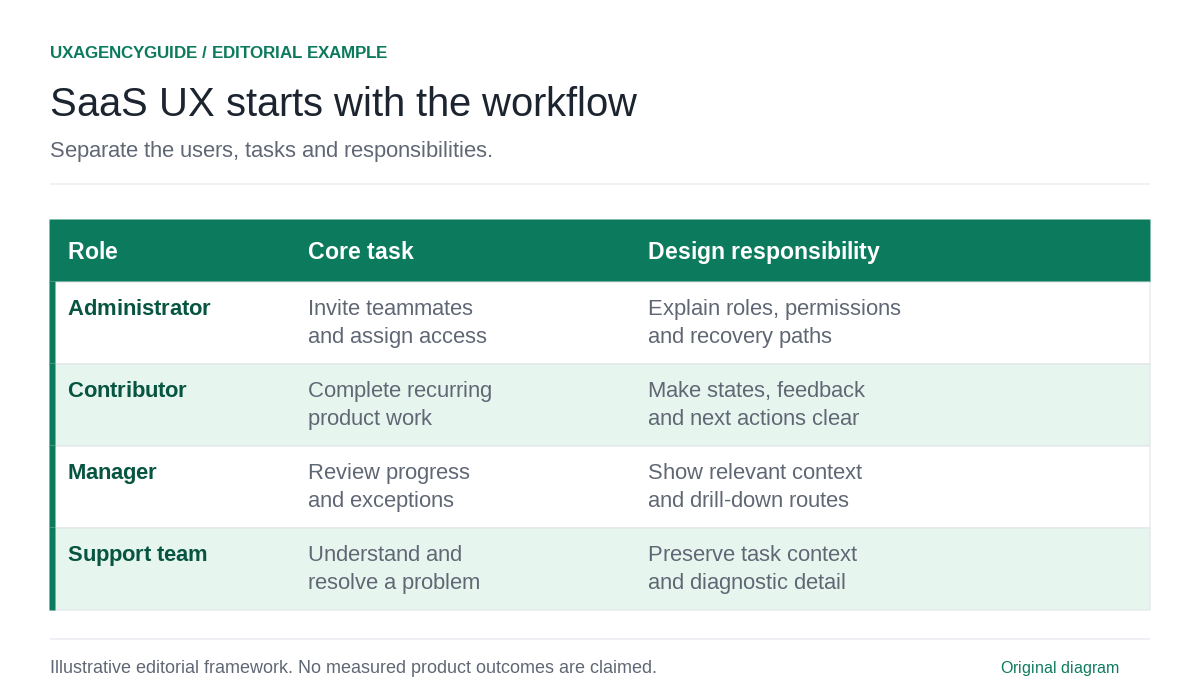
Define first useful value for each role. An administrator may need to configure access before a contributor can do anything useful. A manager may need enough activity to review. A generic onboarding checklist can look complete while leaving one of those roles unable to proceed.
Examine the first real task
Ask the agency to describe how it would investigate the path from account creation to a meaningful task. That may include importing data, inviting a colleague, resolving a permission issue or interpreting an empty state. Signup completion alone is not evidence that the product delivers value.
For an illustrative maintenance SaaS product, a coordinator’s initial useful task is assigning a request. The technician’s useful task is understanding and updating assigned work. The administrator’s task is setting an appropriate permission boundary. Those are connected journeys, not necessarily one shared tour.
Inspect exceptions and recovery
Request a state inventory for a representative workflow. Include first use, missing data, partial completion, restricted access and failed updates. If the portfolio shows only successful populated screens, ask how the agency handles the less convenient parts of the product.
The worked UX audit provides a method for connecting observations to actions. It can help a buyer assess whether an agency’s proposed audit will produce a prioritized decision record or simply a broad list of visual preferences.
Use evidence appropriately
An agency describing a successful onboarding redesign is offering its account. Ask which metric was defined, over what period, for which population and with what other changes. The appropriate conclusion may still be limited. A credible supplier should be able to explain those limits without treating them as a weakness.
Avoid requiring a numerical result for every useful project. A well-documented interaction decision can provide relevant evidence even when commercial measurements are unavailable. The important question is whether the example supports the capability you need.
Embedded teams versus project delivery
A bounded project can suit a defined workflow redesign or a research question with a clear handoff. An embedded arrangement can support continuing release work when product priorities change. Neither model guarantees better communication or more useful evidence by itself.
Define continuity
Ask whether the same people remain assigned, how absences are covered and what happens when priorities change. An ongoing contract can still lose context if staffing changes without a maintained decision record. A short project can provide strong continuity if its handoff is explicit and usable.
Clarify decision authority. Who decides whether a finding changes scope? Who resolves a conflict between a design recommendation and a technical constraint? Who approves a permission rule? Without those owners, the team can generate work quickly while leaving the product decision unresolved.
Make engineering collaboration concrete
Agree on how designers and engineers review states, components and responsive behavior. A handoff link does not automatically communicate business rules. The design should identify intended behavior, while engineering explains what the implementation actually supports.
Set acceptance criteria around the task. A completed design may need editable files, a state map, content, component references and source evidence. An implemented release needs its own verification, including permission behavior, accessibility and recovery. Keep those completion definitions connected but distinct.
Plan ownership after the engagement
Identify who maintains the design system, research archive and unresolved-question list. The internal team should be able to continue without depending on an undocumented explanation from a former supplier. Ask how knowledge is transferred and which source materials remain accessible.
The cost of collaboration includes your own team’s time. Product managers, engineers and domain experts may need to answer questions promptly. A proposal that assumes immediate access to those people should make the dependency visible.
Procurement and handoff questions
Send a brief that names the product, roles, priority task, constraints and available evidence. State whether the assignment concerns the application, the marketing site or both. Include existing engineering ownership and any release commitments that affect the scope.
Ask each shortlisted supplier to respond to the same decision. What should be investigated first? Which work can be reused? What states are essential? What is excluded? This creates comparable proposals without forcing every agency into an artificial hourly-rate contest.
Confirm research logistics, source-file rights, confidentiality and delivery access. Ask whether recruitment, incentives, content and accessibility work are included. If a subcontractor is involved, clarify the responsibility and relevant handling arrangements.
Use a realistic acceptance walkthrough before concluding the engagement. Can the internal team explain the proposed behavior, locate the current source files and identify the remaining unknowns? Can engineering reproduce the intended states? Does the research record support the recommendations?
For a new startup still choosing its first product artifact, begin with the startup agency guide and POC versus prototype versus MVP. For an established SaaS team, the strongest selection process stays close to the recurring workflow and the people responsible for it.
The right agency is the one that can make that work clearer and deliver its agreed contribution reliably. A public shortlist helps you begin the investigation; the scoped proposal, relevant evidence and working-team conversation complete the buying decision.
Review one change across the product
Before expanding a retained engagement, examine a representative change that crosses several surfaces. Adding a new permission role might affect onboarding, settings, a task list, notifications and support explanations. Ask the agency to identify those dependencies and show how the current source remains consistent.
The exercise should include an exception. What happens to an existing user whose access changes while a task is open? Which message appears, and who can resolve the restriction? These questions expose whether the team is designing a connected product or only delivering isolated screens.
Keep the acceptance discussion focused on responsibilities. The agency may specify the interaction while internal engineers own enforcement. The product owner may need to decide the rule before either team can finish. A supplier should make that dependency visible rather than quietly choose a policy on the client’s behalf.
For a SaaS team, this ability to carry a decision across recurring workflows can matter more than the breadth of the first presentation. It supports coherent releases and reduces the chance that a local improvement creates confusion elsewhere in the application.
Frequently asked questions
What distinguishes SaaS UX from marketing-site design?
SaaS product work covers recurring tasks such as setup, permissions, approvals, exceptions and recovery. A marketing-site portfolio alone does not establish experience with those internal application workflows.
Is an embedded design team always better?
No. An embedded arrangement may support continuing release work, while a bounded project can suit a defined question or redesign. Compare continuity, decision ownership and handoff rather than assuming the contract model guarantees quality.
What evidence should an agency provide?
Ask for a relevant named project, its actual role, the decisions investigated and the limits of the evidence. A current proposal should separately confirm staffing, scope, terms and availability.
Sources & evidence
- MVP Design for an HR platformChecked 2026-11-19
- Building confidence in AI for high-stakes legal workChecked 2026-11-19
- Building & Growing the B2B Model For BooksyChecked 2026-11-19
- Just Reach Out: SaaS for media pitchingChecked 2026-11-20
- Cieden: RevvedUp ABM software redesignChecked 2026-11-23
- Qubstudio: BluePalletChecked 2026-11-23
- Fuselab Creative: Agents ManagementChecked 2026-11-23
- Neuron: EnstallChecked 2026-11-23
Specific sources, useful examples and clear limitations make advice easier to assess.
Read the editorial policy