The best UX design agency for a startup is the one whose demonstrated work matches the next product decision, delivery scope and team constraints. A founder validating an unfamiliar workflow needs different support from a SaaS team maintaining a live product. Start with that distinction before comparing portfolios or requesting a price.
This 2027 planning guide examines specific agency-published project evidence checked in November 2026. It is a fit-based shortlist, not an independently scored league table. We have not commissioned these agencies, audited their client outcomes or confirmed their current availability. No agency in this guide paid for inclusion, reviewed the text before publication or has a sponsorship, affiliate, paid-placement or ownership arrangement with the publication. See our disclosure for what this covers and when it was last checked.
Quick picks by startup stage
Treat the following as routes for investigation. The examples support a conversation about scope; they do not establish that one provider is universally superior or affordable for every startup. A historical project can show a kind of contribution without establishing the terms of a new engagement.
| Buying situation | Agencies worth investigating | Evidence to examine | Question before hiring |
|---|---|---|---|
| Early product definition and experience | Metalab, UX Studio, ustwo | Historical early product, prototype or founder-led product work | What evidence will resolve the next uncertainty? |
| Multi-role MVP interface | Arounda, Cieden | Recruitment and cross-party workflow examples | Which roles, states and handoff responsibilities are included? |
| Operational product redesign | Qubstudio | Workforce-management research and redesign | How will existing workflows remain usable during change? |
| Technical or data-heavy workspace | Fuselab Creative | Experiment and workflow interface design | Who owns the data model, rules and implementation? |
| Design coordinated with broader delivery | Netguru | B2B product, development and QA context | Which disciplines will actually be assigned to this project? |
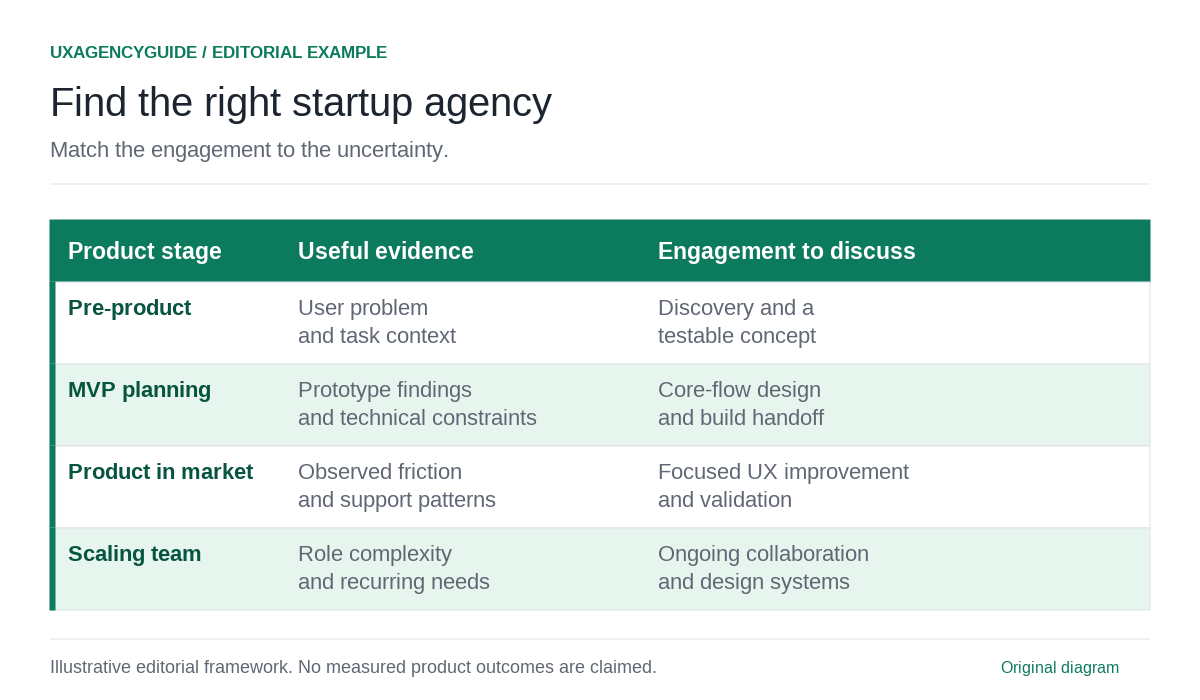
For a pre-product team, a good first engagement might be a bounded discovery and prototype assignment. For a funded team with an existing product, the important need may be research continuity, interaction consistency and reliable engineering handoff. “Startup” describes a company context, not a sufficiently precise design brief.
If the team is still deciding what to build, read the POC, prototype and MVP comparison. If the product already has recurring SaaS workflows, the SaaS agency guide focuses more closely on those buying criteria.
How we evaluate startup agency fit
We prioritize named project evidence, the agency’s documented responsibility and the relationship between that work and a reader’s task. We distinguish research, interaction design, visual design, prototyping and implementation. A provider may cover several disciplines, but a service-page label alone does not prove its role on a specific project.
The source review uses official project pages and relevant service descriptions. Those are primary accounts from the agencies, not independent audits. We avoid repeating growth figures, funding outcomes or client success claims as proof that an agency caused those results. We also exclude pricing assumptions that cannot be verified for the proposed scope.
What a portfolio needs to establish
A useful portfolio conversation explains the starting problem, intended users, constraints, decisions and deliverables. Ask what was researched, what was simulated and what was implemented. A polished screen can show visual craft while leaving those questions unanswered.
Look for responsibility boundaries. An agency may design a product that the client’s engineers build. Another may supply an integrated delivery team. Both can be appropriate, but the startup needs to understand which work remains internal and who resolves disagreements between product, design and engineering.
What this guide does not score
We do not assign fabricated quality scores, compare private quotations or claim firsthand working experience. Current rates, staffing and capacity require a direct conversation. Project examples are selected for relevance, not treated as evidence that every team within an agency has identical experience.
A shortlist should become narrower after discussing your specific work. If it remains a list of famous names with no clear differences in scope, the selection process has not yet answered the buying question.
Agency profiles with project evidence
Metalab: historical early-product design context
Metalab’s archived Slack case describes design and interaction work beginning from an early prototype. It is a useful historical reference for founders considering product experience alongside brand and interface work. It does not establish a current startup package, price or availability.
Ask the proposed team to show a recent engagement with a comparable decision and internal team structure. Clarify whether the assignment includes product definition, research, visual identity, application design or a narrower combination. Do not assume that a well-known historical engagement makes every early-stage brief an appropriate fit.
Arounda: multi-role MVP design
Arounda’s Sinta case identifies MVP design for a recruitment platform and describes interfaces serving different hiring roles. That makes it relevant to a founder whose first release needs coordinated workflows rather than a single attractive screen.
Ask how the agency would prioritize your roles and critical states. Request a clear distinction between design handoff and production engineering. The project account supports a discussion of interface scope; it is not independent evidence of the commercial result a new startup will achieve.
Cieden: cross-party B2B workflows
Cieden’s Sitenna case describes a telecom platform involving operators and landlords, with task, document and map-related interfaces. The agency identifies research-led UX/UI and design-system work, with technical collaboration.
This is a relevant starting point for a startup facing several roles, documents and process dependencies. Ask how the proposed team will investigate the actual workflow and communicate rules to engineering. Confirm the implementation boundary rather than assuming that design consultation means responsibility for all backend development.
UX Studio: research-led prototype work
UX Studio’s Inquisita case describes research and a clickable prototype for a legal discovery assistant. The prototype boundary matters: the account is relevant to early interaction and trust questions, not proof that the agency released a production legal service.
For a founder, the useful question is how findings change the concept before implementation. Ask which participants, tasks and states would be included in your engagement, and what remains uncertain afterward. Do not infer domain compliance or a successful launch from prototype work alone.
Qubstudio: operational redesign with existing users
Qubstudio’s Workforce Velocity case describes research, audit, redesign and design-system work in an HRTech context. It is especially relevant to the question of changing a role-heavy operational product without ignoring established workflows.
A startup with an existing customer base should ask about migration, incremental releases and the treatment of familiar behavior. The important evidence is how a supplier manages change, not simply whether the redesigned screens look more contemporary. Confirm the terms of a new engagement directly.
Fuselab Creative: technical and data-heavy interfaces
Fuselab Creative’s Grid.ai account describes UI/UX and design-system work for machine-learning workspace surfaces. It explicitly distinguishes the agency’s design contribution from implementation by the client’s internal developers.
That boundary is useful for founders who already have engineering capability but need help with complex information and interaction states. Ask how design decisions will connect to the real data and permission model. Do not treat a detailed interface design as proof that the supplier will operate the underlying technical system.
Netguru: design within broader product delivery
Netguru’s Booksy B2B case describes a broader product context involving design, development and QA. It offers a starting point when the startup needs design coordination across several delivery disciplines.
Ask which roles are included in the actual proposal, who is assigned and who owns acceptance. A provider’s broad capabilities do not mean every engagement includes every discipline. Separate the work you need now from optional implementation or scaling support.
ustwo: founder-led consumer product work
ustwo’s Mavie case describes a maternal-wellness product developed with its founder, including product experience and technical foundations. It is a context-specific reference for early consumer product development.
Ask how the team would define recurring value and prioritize a small release in your market. Preserve the domain boundary: wellness product experience does not establish clinical effectiveness or certification. The relevance lies in the documented product-building scope, not an unsupported promise about outcomes.
Side-by-side: stage, scope, project and published terms
The table puts the eight profiles on one page. The stage and scope columns are our reading of the cited project; the published terms are what each agency’s own website showed on 20 November 2026, taken from our UX agency hiring benchmark. “Not published” means we did not find a price on the pages we reviewed, not that the agency has no minimum.
| Agency | Startup stage it fits | Scope in the cited project | Named project | Published price or minimum (20 Nov 2026) | Question to ask first |
|---|---|---|---|---|---|
| Metalab | Early product definition | Product and interaction design from an early prototype (historical) | Slack (archived case) | Not published | Which recent project had a team and decision like ours? |
| Arounda | First release with several user roles | MVP interface design for several hiring roles | Sinta | Redesigns from $5,000; typical projects from $6,000; monthly designer tiers with a free 3-day trial | Which roles and states are in the first release, and who builds it? |
| Cieden | B2B workflow with several parties | Research-led UX/UI and design system, with technical collaboration | Sitenna | UX audits from $2,000; AI prototyping sprint from $8,000 | How will you map the real workflow before designing screens? |
| UX Studio | Testing a concept before building | Research and a clickable prototype | Inquisita | Not published; free 5-day trial | Which participants and tasks will the prototype be tested with? |
| Qubstudio | Redesigning a live product with existing users | Research, audit, redesign and design system | Workforce Velocity | Not published; UX health check up to 2 weeks | How will current users keep working during the change? |
| Fuselab Creative | Technical or data-heavy product with its own engineers | UI/UX and design system; client’s developers built it | Grid.ai (Lightning AI) | $100 to $150 per hour; engagements from $25,000 | Who owns the data model and the implementation? |
| Netguru | Design inside a wider delivery team | Design, development and QA | Booksy B2B | Not published; discovery 2 to 6 weeks | Which disciplines are in this proposal, by name? |
| ustwo | Founder-led consumer product | Product experience and technical foundations | Mavie | Not published; Discover from 8 weeks | What is the smallest release that proves recurring value? |
Two patterns stand out. First, the agencies with the lowest published entry points (Cieden’s audit, Arounda’s redesign tiers) publish fixed-scope offers, which suit a startup that needs one bounded piece of work. Second, the agencies that publish durations rather than prices (Netguru, ustwo, Qubstudio) describe multi-week discovery or audit phases, so plan for that time before any build starts. In both cases, compare written proposals for the same scope rather than these starting figures.
Research, prototyping and delivery scope
Write the engagement around a decision. A founder may need to understand a customer problem, compare possible flows or prepare a bounded release. Those needs produce different deliverables. “Design an MVP” is not enough unless the proposal explains the task, users, states, research and implementation responsibilities.
Research should connect to an action
Ask what the agency will investigate and how the answer will affect the product. A workshop can align assumptions, but it is not automatically evidence from intended users. A participant interview can reveal context, but it does not by itself establish how people will use a proposed interface.
Request the research question, recruitment approach, task or interview plan and evidence handoff. The research-methods guide explains how to distinguish those choices. Good procurement makes the expected evidence visible before the work begins.
Prototype scope needs states
An invitation flow may need role selection, validation, pending status, failure and recovery. A prototype covering only the successful path can miss the question that matters most. Use the artifact comparison to specify what the representation must show.
Also define whether the prototype is disposable or expected to inform implementation. Editable source files, component references and interaction notes can help the internal team continue the work. Exported images alone may not support that handoff.
Budget and collaboration trade-offs
A published minimum engagement is not a quote for a complete product. Scope varies with research access, number of roles, state complexity, content responsibilities and the engineering boundary. Compare proposals through those inclusions before comparing totals. If you are still deciding whether an agency is the right model at all, our agency vs. freelancer vs. in-house comparison sets out the trade-offs.
A fixed project can make sense when the task and deliverables are stable. A retained or embedded arrangement may suit a product with continuing discovery and release work. Neither model guarantees continuity. Ask who remains assigned, how replacements are handled and how decisions are documented.
Account for the startup’s own effort
The founder may need to provide domain access, recruit participants, answer product-rule questions and coordinate engineering. If the proposal assumes those inputs arrive quickly, delays can change the economics. Name the dependencies and the person responsible for each one.
Compare total responsibility, not just design hours. A lower fee that excludes research, content and handoff may require substantial internal work. A broader proposal may include services the startup does not need. The useful comparison is the smallest complete engagement that supports the intended decision.
Protect continuity and ownership
Agree on access to editable files, research notes and relevant design-system material. Clarify what happens if the engagement ends early. The startup should be able to understand what was decided, what remains unresolved and what rights it has to use the delivered material.
Avoid importing confidential customer information into a supplier’s tools without an agreed handling process. A realistic prototype can use synthetic data where appropriate. Research participation and recording also need a clear operational owner.
Questions to ask before hiring
Ask the proposed team to walk through a comparable task from problem to handoff. Request an explanation of a difficult decision and a limitation in the evidence. This is more informative than a presentation consisting only of finished screens and broad success statements.
Then ask how the team would scope your first engagement. What question comes first? Which role and flow receive attention? What is deliberately excluded? What would cause the team to recommend changing direction rather than continuing toward the original concept?
Confirm the working team, communication rhythm, decision authority and engineering contact. A strong portfolio does not resolve whether the proposed collaboration fits the founder’s availability and internal capabilities. Make those expectations concrete before signing.
Finally, define acceptance in terms of the agreed work and its evidence. A delivered prototype can be complete for exploration while still requiring production engineering. A research report can identify an unanswered question rather than validate the founder’s preferred idea. The right agency engagement makes those distinctions clear and leaves the startup with a better-informed next step.
Keep the shortlist short enough for meaningful conversations. Send the same scoped brief, ask for comparable inclusions and document what each supplier confirms. That creates a defensible selection process without pretending that a public list can decide the purchase on your behalf.
Compare two proposals through the same scenario
Imagine a founder with an engineer already assigned to a maintenance product. One proposal offers a visual refresh of ten screens. Another offers research on the assignment workflow, a smaller prototype and explicit permission-state documentation. Neither is automatically better. If the uncertainty concerns whether coordinators understand responsibility, the second scope addresses more of the actual decision. If the workflow is already established and implementation needs a consistent visual system, the first may deserve closer examination.
Ask both suppliers to explain the trade-off in writing. The response can reveal whether the agency understands the product problem or is simply fitting it to a familiar package. It also gives the founder a basis for discussing exclusions without turning every difference into a demand for more screens.
Watch the first handoff
An initial engagement should leave the internal team able to continue. Ask the engineer to inspect one important state and the founder to explain one research-backed decision. If either depends on an undocumented verbal explanation, improve the handoff before expanding the contract.
This is a practical collaboration check, not a substitute for reference conversations or contractual review. Its value is making the proposed partnership concrete. The startup learns whether evidence, decisions and files move through the working team in a form that can support the next release.
Frequently asked questions
How should a startup shortlist UX agencies?
Define the product stage, priority task, internal capabilities and evidence needed. Compare agencies through specific project roles and ask the proposed team to explain a comparable decision before requesting a scoped proposal.
Does a famous project establish current startup fit?
A historical project can show a type of contribution, but it does not establish current availability, pricing or the team assigned to a new engagement. Confirm those conditions directly.
Should design and development come from one supplier?
Either model can work. Define who owns product rules, interface states, implementation and acceptance so that a broader supplier or a design-only partner can be assessed against the actual scope.
Sources & evidence
- Slack product design case studyChecked 2026-11-19
- MVP Design for an HR platformChecked 2026-11-19
- Sitenna Telecom Design Case StudyChecked 2026-11-19
- Building confidence in AI for high-stakes legal workChecked 2026-11-19
- Workforce Velocity HRTech Platform RedesignChecked 2026-11-19
- Grid.ai / Lightning AI Machine Learning Dashboard DesignChecked 2026-11-19
- Building & Growing the B2B Model For BooksyChecked 2026-11-19
- Mavie x ustwoChecked 2026-11-19
Specific sources, useful examples and clear limitations make advice easier to assess.
Read the editorial policy